Translate

Showing posts with label Duolingo. Show all posts

Thursday, June 6, 2019

Duolingo - You can have it your way


How can I best learn a new language?  Oh, if I only knew the answer to that seemingly innocuous question.  Lots of us want to learn another language, but few of us succeed.   My best advice is to give DuoLingo a try.  DuoLingo is a web-based language learning program available for desktops, laptops, and mobile devices.  Two of the pluses of DuoLingo are that it has a perfectly acceptable free version and that you can tailor it to your own needs.  Is it the panacea for all language learning problems?  No, sorry.  But I have been using it for about six years and still look forward to using it on a daily basis. Here is the advice I would give a friend who wants to acquire another language using DuoLingo.


First, choose a language that is meaningful to your life. DuoLingo offers a wide variety of languages.You may be planning a trip to a foreign country, have friends who speak another language,, enjoy the music from a certain country, want to connect with your roots, or learn about a new culture.  I study Spanish and Portuguese because I have taught those subjects, French because I have French-speaking Canadian friends and enjoy traveling in Canada, Italian because a good friend has just bought a flat in Venice, and Irish and Welsh because I am intrigued by Celtic cultures.  And if you find that you chose the wrong one, you can quit it and start a new one.  I once began Catalan and  Romanian because they are Romance languages, but I quickly lost interest, probably because I didn't have a personal connection.


Next, set a daily goal ( a small one is fine) or let DuoLingo set one for you.  The program can be instructed to send you reminders if you don't meet your daily goal. I used them at first to develop the habit of doing some bit of language every day, but after a while, the reminders began to feel like a nag.  Now my strategy is to gain ten points every day, which is really easy.  I have a streak going of over 1800 days.  You may laugh, but I go to great lengths to maintain my DuoLingo streak.  However, in addition, my personal daily goal is to do one exercise in six different languages every day without making five errors.  Duolingo lets me know when I make an error by losing one of my five available hearts. So, my advice is to play around with your goal so that it fits your lifestyle.


Now to the content that DuoLingo offers.  You will choose topics to work on, some based on life experiences, like travel, and others based on grammar, like past progressive verbs.  Once again, you are in charge here.  The topics are arranged from easier to more advanced, but you don't have to necessarily work through them in a lock step fashion.  Remember, language learning can be a truly enjoyable experience. Language Acquisition experts talk about the important role of Language Input, that is, getting lots of language into your head in a comprehensible way. Duolingo offers an impressive amount of content.


Another piece of advice is to allow yourself to explore what DuoLingo offers.  There is no one right way to use it.  DuoLingo is constantly changing,  so you may log in one day and find new features.  I can compare it to learning how to use an iPhone or an Apple Watch.  You will discover capabilities you want to use and others of no interest.  On Duolingo, I have explored grammar explanations (pretty boring), jump ahead quizzes (great), vocabulary count (not useful), online discussions (pretty interesting if you have time), and adding friends to compete with (not so interesting anymore).  Just keep clicking around in the program until you find features that suit you.

Now back to the thorny question of how to learn a language.  I can only say that DuoLingo will help you along in your journey.  The program gives me an opportunity to maintain Spanish and Portuguese, helps me feel that I am not losing the French I learned in school, gives me hope that the next time I am in Italy I can use more Italian than the last time, and provides an intellectual challenge figuring out the workings of Irish and Welsh.   


My plea to Duolingo is: Please bring back the 'bots'.   The bots carried on a conversation with you to which you replied speaking or in writing.  Talking to the bots was very close to having a conversation with a real person, which means that you were creating language in your own head.  I loved talking to them.   But the bots unfortunately only made a brief appearance in the program.

Is DuoLingo the ultimate answer to the question, "How do I best learn a language?" No, but it is a flexible, motivating way to study language. And I look forward to a future where language learning is even more accessible. 

 If you are a DuoLingo user or want to be, I look forward to reading your comments and observations on language learning!




Sunday, November 4, 2018

Does Speaking a Language merit the Gold Medal?


"I'm studying French."  "Really?  Can you speak it?" Most people think that knowing a language means speaking the language. But is speaking a language truly the only worthy goal of language study?

No one, least of all me, can deny the thrill of successful conversation in another language with a native speaker.


I can still remember a few of those exchanges in my past and the satisfaction they brought me. For example, the customs inspector as I was leaving Brazil after six weeks of language immersion told me I spoke Portuguese "bastante bem" (quite well).  A fellow party-goer in Mexico City where I was studying Spanish didn't realize at first that I was American.  And, even in my home town on the border, El Paso, Texas,  I still get a kick out of rare times when I am speaking in Spanish to a native Spanish speaker who doesn't  immediately switch to English. 

Recently, however, I have been taking a more practical approach to language study, which I do mostly on Duolingo.


Duolingo is a language learning program, available in a wide variety of languages on the Internet in web based and mobile platforms at no cost.  It isn't perfect, but it is the best program I have found to date for doing a bit of language study faithfully every day.

My thirty-minute morning goal is to successfully complete one exercise in six languages.  I study Spanish and Portuguese in order to maintain speaking proficiency because those languages were my teaching fields.  I also study French, Italian, Irish, and Welsh in order to ...what?  Will I have the opportunity to use those languages in conversation?  Much as I like to dream of extended vacations to Canada, Italy, Ireland and Wales, happily conversing with natives of those countries, let's get real here!  And I know of no French, Italian, Irish or Welsh speakers in my hometown of El Paso, Texas, who want to meet up for coffee and conversation. 

Unfortunately, Duolingo does not at present provide enough opportunities for creative language use, although a promising feature was available for a short time in the past. With that feature, you could communicate orally with a "bot,"  which came very close to a real-life situation, because you truly had to create language.


 I have hopes that Duolingo will continue to introduce innovations for the speaking skill.  

In the meantime, though, I must be content with learning ABOUT some languages rather than learning to SPEAK them.  And is that worth my time and effort?  Yes, and here's why I think so.   

* I enjoy the mental gymnastics of language learning (a term coined by the linguist, Stephen Krashen).  Surely the effort it takes to analyze another language qualifies as one of the methods of keeping the brain active.

* I feel a connection to the countries and speakers whose language I can at least read, which makes international news a lot more interesting.

* I believe that analyzing the various ways in which other languages express meaning makes me more in tune to how speakers use English, my native language. Random overheard conversations, radio, TV and signs are all fodder for thinking about language in general.

* I think about language study as an enjoyable daily activity, something I can use to reward myself for completing household duties.

So, is speaking a language awarded the gold medal for language study?  Yes, it is.  But  I will be very content with the silver and the bronze medals for reading, writing, and understanding the structure of many other languages.


Monday, August 27, 2018

Beating a Language Study Slump

Most of my posts to this Language Lover's Blog are filled with enthusiasm about studying other languages. I have published 155 posts over the past five years extolling the virtues of foreign language acquisition.  I promised readers they would fall in love with languages, develop a lifelong fascinating hobby, and perhaps even ward off dementia for a few years.  

Now I find myself in the embarrassing position of not being excited about languages anymore. Yes, I have said it.  Just like my favorite major league baseball team, the Los Angeles Dodgers, I am in a slump.


 And just like the hitters who can't connect with the ball like they used to or the pitchers who can no longer throw strikes, I can't put my finger on what the problem is or how to solve it. I wish I had Yogi Berra's philosophy.


The problem of maintaining motivation looms large in the field of foreign language acquisition. You may have experienced it yourself.  As you start to learn a new language, you are on an uphill trajectory.  You promise yourself to study every day, sign up for a course, use online apps, and plan a trip to use your new language.  Ah, I remember those innocent days! Reality soon makes hash of your good intentions, and to paraphrase Yogi Berra, you aren't in a slump, you just aren't acquiring the language of your choice.

Take my desire to learn Italian, for example.  With plans for a summer trip to Tuscany with friends and family, I felt fairly confident that I could learn a lot of Italian before the trip.  After all, I have degrees in foreign languages, I have taught foreign languages, and Italian is a Romance language similar to Spanish and Portuguese, which I know fairly well.  What could go wrong?

I signed up for a six-week Italian class at an institute on a local university campus.  The details are irrelevant, but suffice it to say that the only thing I learned about Italian was that "ci,","ce," "gi," and "ge" were going to give me lots of trouble.  I did not sign up for the second six weeks.

My next effort was to sign up for Italian on Duolingo, a popular online language learning course, available on the web or as an app on mobile devices.  I had been using Duolingo for several years to study a variety of other languages and thought it was great fun.  About this time, though, Duolingo made a significant change in the program.  In the old version, you were allowed to make mistakes and keep trying to answer correctly with no penalty.  It was a relaxing way to learn.

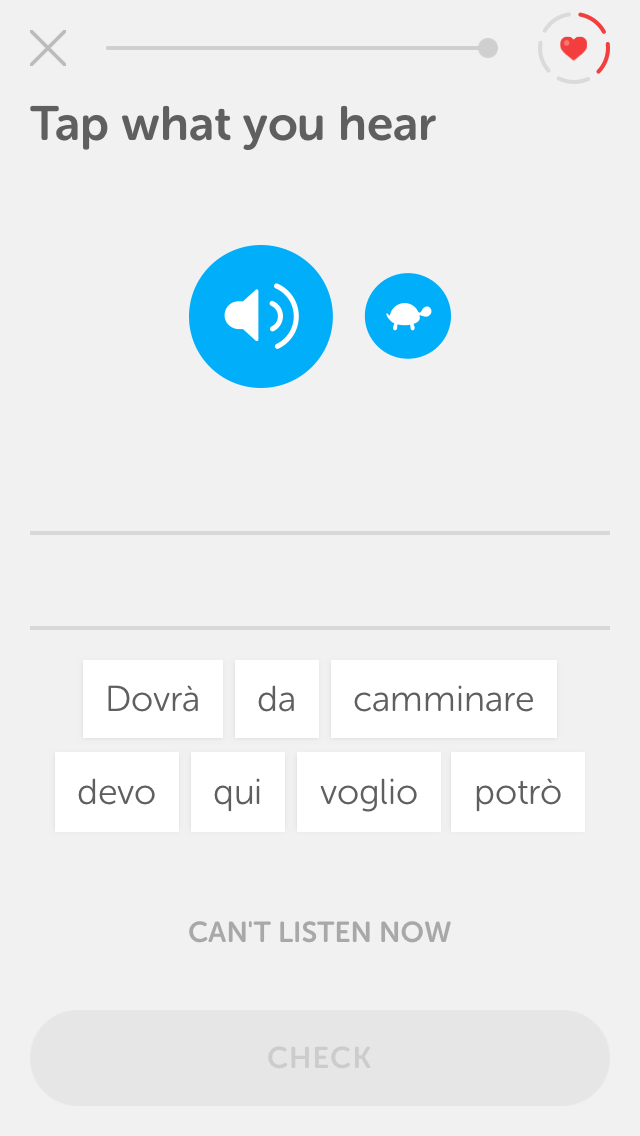
The new version of Duolingo allows only a certain numbers of errors before your "health meter" runs out of segments.


Note health meter in top right hand corner


Unless you can buy back your "health," you have to wait more than four hours to regain it and continue practicing.  Needless to say, I found nothing motivational about the new rules.

Another change in Duolingo that I missed was the absence of "bots."  At one time, you could hold an actual conversation with a bot by typing or saying your answer.  I loved talking to the bots and learned a lot about conversational language in Spanish, Portuguese and French.  Sadly, though, I did not have this opportunity in Italian.

You probably know where all of this complaining is going.  We had a great trip to Italy, but I spoke virtually no Italian and understood less.  I found myself gesturing and pointing like a first year language student to even order a gelato.  

What do baseball players do when they hit a slump?  They keep on swinging and pitching.  I'll keep studying languages on Duolingo because I have a 1561 day streak going, and I hate to be a quitter.  Maybe, just maybe,  the thrill of language learning will return to me one of these days.


Saturday, June 16, 2018

DuoLingo Wants to Crown You

One morning not long ago, I logged onto my DuoLingo language learning program and discovered a new feature — a gold crown attached to each of the topics.


DuoLingo is my favorite free online language learning program.  I must enjoy it because I have been using it on a daily basis since 2014.  I began by studying the Spanish language and soon added five other languages.

DuoLingo often adds new features which the user needs to experiment with to understand.  The first thing I noticed was that the crown levels add a surprising amount of new material  (five more levels) to each topic. For me in Spanish, this feature was welcome because I had long ago completed the "tree" which contains all of the possible vocabulary and grammar topics. A new challenge was just what I needed to add complexity to my Spanish study.

So I jumped right in with my iPhone and started a crown level.  A new circular counter with five segments appeared in the upper right-hand corner of the screen.  What was that I wondered?  I soon found out. Every time I made an error of any kind, a segment of the counter disappeared.


Only two segments left!

And when all the segments were gone?  I had "lost"and was not allowed to continue with the program until I regained my "health." 


Out of health!


My options were:  (1) Spend 450 of the gems I had collected on the program to refill. (2) Purchase gems for cold hard cash from the program to refill. (3) Wait about five hours for my health to be automatically refilled. (4)  Trudge up the stairs to my laptop and do a few easy lessons to refill the counter. (The web version doesn't have crowns or counters.) (5) Buy DuoLingo Plus for a monthly fee.  

None of these options would help me progress in my language study.  As a business model for DuoLingo, I can understand what the program wants the user to do.  But from the viewpoint of a language learner, cutting off my language learning is not at all helpful.


One of the big controversies in language instruction is whether error correction helps or hinders a learner.


On the DuoLingo web version, a line appearing at the top of the screen advances or retreats depending on whether you give a right or wrong answer; however, you are allowed unlimited access with no penalties.  The web system is a gentler form of error correction.  The new mobile crown system is much more punitive.  Imagine if I were to make a language error speaking in real life and be barred from further conversation unless I paid a ransom or waited several hours! That just isn't realistic.

DuoLingo is the best language learning platform that I have found.  It is accessible, motivating, and innovative.  The stated mission of the program is free language education for the world.  I love it and use it every day.

But that darn health meter really bugs me and gets in the way of my language progress.  I wish I could log onto DuoLingo one day in the future and find that those intimidating counters were just another failed experiment.


Tuesday, May 22, 2018

DuoLingo Has Something for Everyone


Most people I chat with these days about language study mention they are using DuoLingo, a free,  popular internet program. I am a devotee of DuoLingo and have been using it every day for over four years (I have a 1465 day streak going—obsessive, right?)  I study four Romance languages and two Celtic languages.  DuoLingo offers an impressive array of languages and frequently adds new languages.. You can do Duolingo on a computer or a mobile device.

If you haven't been introduced to DuoLingo yet, let me try to summarize it. Warning: the program is addictive.  You are presented with a series of exercises in the language of your choice based on vocabulary and grammar topics, such as "to be" or "business."


Each exercise has approximately ten parts which may be listening, speaking, reading or writing activities. Answers can be submitted by keyboard or voice. If you complete an exercise successfully, you hear a pleasant computer sound and are awarded 10 or more experience points (XP's). That is the heart of the program. But DuoLingo consists of more optional features to personalize the language learning experience.  Which types of personality might use the various features, I wondered?

Language Geeks


As I began to use DuoLingo, I was both surprised and heartened to learn how many language geeks besides myself are out in the world.  For example, in the web version, after submitting each answer, DuoLingo gives you the option of discussing it with other users.  Who would have predicted that there would be so many passionate and complex exchanges about grammar and vocabulary? An example from DuoLingo Spanish, one of 103 entries about translating "We drink milk," is "Can someone help me understand the difference between bebe, bebes, bemos (sic) and bebemos?" 


Another feature that language geeks may enjoy is clicking the "report" button if they disagree with the correct answer.  I have done that myself a few times and have even received a reply back from DuoLingo saying that my answer would now be accepted.  Ah, the joy of righting a wrong in the world!

A "share" version on the mobile version allows users the option of sending an answer to someone or some place.  I just discovered one possibility, "Add to Notes," that may work for recording something I want to ponder at my leisure.

Finally, language geeks may be intrigued by the offerings of two invented languages,  Klingon and High Valyrian, recent additions to DuoLingo.


Old School Users


If your first experience studying another language was in a grade or high school classroom, as mine was, you may be searching for DuoLingo features that look and feel familiar.  Both the web and mobile versions have buttons to click to read short grammar explanations. You click on the light bulb in the web version to learn more about the topic.


You can also take a teacher role by clicking on the "Review" button after each exercise and comparing your erroneous answers to the correct ones.

As students, we are comfortable with ability levels (remember Blue Bird and Red Bird groups in kinder?).  DuoLingo allows users to progress through levels, with material becoming increasing challenging.  Recently DuoLingo introduced "crown" levels which give users even more challenge and practice (sort of like additional pages in a workbook). 


The good news is that the web version makes the crown levels easier to achieve because the consequences of wrong answers are not as dire as on the mobile version.  (This is a controversial topic for another day.)


Another feature that old school users may recognize is found under "Labs" on the web version.  I recently clicked on several of the interactive Spanish stories and found the experience familiar and enjoyable. 

Social Butterflies

As an introvert, I may not be the best person to comment on social opportunities on DuoLingo, but I do realize that connecting to other language learners is important.  The web version of  DuoLingo has an active discussion board where I have received good advice from time to time, usually about how to use a new DuoLingo feature. And be advised that DuoLingo does throw new features at you without warning for which you may need a little help from your online friends.

Another social media type feature of DuoLingo on the mobile version is an icon called "Clubs."  I haven't explored it fully, but at first glance it looks like a sort of Facebook for DuoLingo users.

Another less demanding social aspect of DuoLingo is following other users and having them follow you.  You can check your Leader Board to see how the amount of experience points you achieve compares to people that you follow. And be advised that there is always someone out there who is ahead of you. 


I try to imagine some of these leaders who are way out front.  Do they have a life?

No matter what your age, personality, language background or skill with technology, I believe that if you have an interest in other languages for whatever purpose that you can find what you want on DuoLingo to personalize the language learning experience.  And remember, DuoLingo is free and may become your favorite healthy habit.


Friday, December 15, 2017

How much Italian can I learn in six months?


In six months, I hope to be relaxing by the pool in a villa in Tuscany with friends and family.


And, before we leave,  I intend to indulge my passion for other languages by learning something of the Italian language.  I may never overcome my introverted nature to actually speak to an Italian, but what a super excuse to learn something about another language.  The question is:  How much Italian can I reasonably learn before I arrive in Italy?

Setting an appropriate goal for second language learning is anything but a straightforward decision. I often start with a lofty goal and then give up.  So many factors must be considered — time available for study, dedication to study, materials to utilize, opportunities to practice the language, former experiences with languages, the list goes on.

First I have to curb my enthusiasm for a new language.  I must admit to being a bit of a language junkie, always wanting to try something novel and exciting.  Will I ever be able to read Dante's Inferno in the original Italian?  Doubtful.  I probably won't even get around to reading an English translation of it, if the truth be known.  Will I be able to understand conversations around me in Italian?  Also, very doubtful, unless they are close enough to Spanish or Portuguese to catch the drift.  Will I be able to work out a problem at the train ticket window in Italian?  Also, extremely doubtful.  Stressful situations do not bring out my best language efforts.

So with these caveats in mind, what can I reasonably expect to accomplish in Italian from January to June, keeping in mind that the real world has a habit of messing with our best laid plans?  Here's the study list I am planning to start with.

* Learn the sounds of Italian that are different from other Romance languages I have studied.  Being able to read and pronounce even names of locations is a great help in planning a trip and navigating once we arrive.  My husband, Wayne, and I once made a reservation at a B&B on the Isle of Mull in Scotland, the Bredalbane.  We had been calling it the BREdalbane, and couldn't figure out why no one could give us directions to it until someone realized we are asking for the BreDALbane.

*Make a list of twenty possible questions on flashcards that I may ask in Italy, such as, "Where is the train station?", "How much does it cost?", or "Please bring me a coffee."  

*Make a list of three possible responses on the reverse of each of the question flashcards above.  It is pretty scary to ask a question in a foreign language if you fear that you can't understand the answer.

*Complete the "tree" in Italian on DuoLingo to get an overview of essential grammar and vocabulary.


This knowledge will be especially useful in reading signs and menus.  As an added bonus, I get to analyze how the Italian language is put together, just to satisfy my curiosity.

*Investigate other online language learning apps, such as Italian by Nemo, which gives the opportunity to pronounce Italian and listen to yourself to check pronunciation against the original.  Listening to myself speak Italian may give me confidence to speak, or not, depending on how I judge my performance!

* Pledge an extra 10 minutes a day to study Italian along with my daily study of other languages on Duolingo.


Hmm.  Where do they say that road leads that is paved with good intentions?   I would love to hear about successful activities of other language learners, just to keep myself motivated.  So many fun things to do in life, so little time! 

Saturday, October 7, 2017

A quick glance at the Catalán language


Do you speak Catalan?


I'm sure you have seen or heard, as I have, recent news reports of the independence movement in Catalonia, Spain.  How little I know about this autonomous region of Spain, and how little I know about the Catalan language!

A previous spark of interest in this language hit me several years ago during a family trip to Barcelona, the capital city of Catalonia (see "So many languages, so little time" in this blog, 2/10/16).


Barcelona

But as usually happens with me, I visit a country, get super-hyped about learning the local language, and then let my fickle language learning self put it to one side when I return home.

Now Catalan is calling to me again, although I am realistic enough to know I will never be a Catalan speaker.  But I would like to become better acquainted with this language that plays such a large part in cultural identity.

First, some basic facts about Catalan.  It is a Romance language, descended from Latin, like its sister languages French, Italian, Portuguese, and Spanish, among others.  Nine to ten million persons currently speak Catalan.

Romance Languages Family Tree


Catalan is spoken in the small country of Andorra, where it is the national and official language, and in Catalonia, the Balearic Islands, Valencia (called valenciano), and even a town in Italy and some regions in France.


Catalan-speaking regions


Beware of calling Catalan a dialect of Spanish!  It is a separate language. Monolingual Spanish and Catalan speakers cannot readily understand each other. Also, Catalan itself has six different dialects, evidence that it is a separate language. The written versions, however, of both Spanish and Catalan may appear similar enough for the reader to make an educated guess at meaning.

Because Catalan sounds like a mixture of Spanish, French and Italian (closer to French and Italian than Spanish), and I study those Romance languages, I am lulled into thinking that I should be able to at least understand Catalan.  Not! So I turn to my favorite online language learning program, Duolingo, to investigate Catalan.  It is available as a language for Spanish speakers to study.


Duolingo Catalan Lesson One


I tried out the first Catalan lesson on Duolingo. If you are acquainted with Spanish, see if you can guess the meaning of these Catalan words and expressions that I encountered.

un home
una nena
una dona
un nen
Sóc un home.
Jo sóc un nen.
Jo sóc una nena.

Some words look comfortingly familiar.  Un and Una are indefinite articles (a or an in English). Home looks like a shortened form of hombre (man), nena is close to niña (girl), and nen is fairly close to niño (boy).  Jo looks like yo (I), so  jo sóc  probably means yo soy (I am).

The spoken language may be more of a challenge, however.  A web search revealed some letters that  take special attention.  The letter combination "nya" is equivalent to the Spanish ñ, which is why you will often see the province name of Cataluña (in Spanish) written in Catalan as Catalunya. 

The "x" is a distinctive letter.  Can you guess the meaning of xocolata, one of my favorite comfort foods? The ç is an "ss" sound, as in the Catalan word for "to begin," començar. The "ny" is like a Spanish ñ, but with no vowel sound afterward, so baño (bath) becomes bany in Catalan.  And I also discovered that the "ll" is a different, harder sound than  the "y" sound those letters make in Spanish.

I'm going to leave Catalan on my list of Duolingo languages to study daily. The allure of using knowledge from other Romance languages to make quick progress in Catalan is too strong to pass up.  What an enjoyable way to learn about another culture!


Tuesday, September 19, 2017

When bad things happen to good language learners


"Into each life some rain must fall."  I'm okay with that, but I wish downturns in life didn't have such an adverse effect on my language study.  So far I have managed to keep a month long bout with bronchitis from ruining a 1223 day streak on my favorite online language learning platform, Duolingo. Many of those days were earned by me lying in bed, bleary-eyed, fumbling for my cell phone and completing a quick set of exercises in Spanish, which I can pretty much do automatically, just to get credit for the day.  Other languages I had been following on Duolingo were left by the wayside like sad unwanted pets.

And I don't think language study necessarily equates to the common wisdom about riding bicycles, for example, that once you learn how to ride, you don't forget.  If languages are not practiced daily, they begin to fade in our brains, until finally, it is just too much trouble to go searching for them. I've got to get back to those other languages, TODAY!

Other bad things can happen to good language learners as well.  Have you ever been stuck at what feels like a plateau of a new language?  


You keep trudging along, but the scenery remains the same.  You don't feel you are making progress in your language. You know a little;  you want to know a lot more.  How good it would feel to finally master a new language.  (Note:  You probably won't!  Once you decide to truly learn another language, it will always be in progress in your life.) 

The Irish language is my plateau at the moment. Shall I study a new grammar topic, practice pronunciation, or try to read a Facebook message in Irish? I need to give serious thought to what efforts I can make to take me across the plateau  so that I can climb the next mountain.


Another pitfall for language learners is the very common phenomenon of loss of interest in a language or culture.  A while back, I got very excited about studying Romanian on Duolingo, partially because it is a Romance language.  I could readily recognize some vocabulary and grammatical features in the beginning exercises.  Then it got difficult.  I got impatient when I couldn't whiz through an exercise.  So I started rationalizing, telling myself I will probably never have the chance to travel to Romania, and that I have other fish to fry.  Now I have left this perfectly lovely language for so long that it will be just a memory, a fleeting moment of a peek into another culture.


Romanian Castle


Then there is the case of Italian. Big plans were being discussed for a family trip to Italy next summer, complete with a rented villa, trains excursions in Switzerland, and an international motorcycle race.  I can do Italian, I thought, and raced through the Duolingo exercises.  Plans change, as life does, so we may now be going to the Netherlands or Germany.  Duolingo makes it so easy to add new languages without deleting old ones, which appear like ghost icons on my start-up page. I'm resisting the urge to click on Dutch or Germany until travel plans become more concrete. but I hear the siren call of a new language. 

We all start out with the best of intentions of being good language learners.  With a little more discipline and a little less complaining about the vicissitudes of life, we can get back on the track and enjoy language study every day of our lives.

Thursday, September 7, 2017

Five ways to sabotage your language learning - Ranked


If you are reading this post, you probably have experienced a mind set similar to my present one. I am enthralled with the Irish language.  I want to make it one of the languages I mention with pride that I study.  But I have reached a learning plateau that is starting to feel like Mt. Everest. 

So this post is really me talking to me, not Ms. Fitich, the bossy Spanish teacher you may have had in seventh grade, telling you how you should learn a new language.

Do you sabotage your language study in these ways?

I Only study when you are really in the mood.  After all, you chose to study the new language, right?  It should be on the fun list in your life, not the duty list, right? Why ruin perfectly good leisure time by studying, when you could be checking your email again, browsing a new clothes magazine that just came in the mail, changing the cat's water (you can continue this list).  

With language study, slow and steady wins the race.  A small amount of study every day produces better results than longer, less frequent (and probably guilt-driven) longer sessions.


Doing something, I might say, almost anything with the new language will keep it active in your brain so you don't have to dig so hard to find it again.  You can use any of the language skills, listening, speaking, reading or writing, just as long as you do something that forces your brain to engage in the new language.


II. Give in to the need to master every grammar bit before moving on. My husband, Wayne, whom I have turned into a duoLingo addict, complained recently that he couldn't do the exercise on Spanish adverbs and was feeling discouraged.  My advice was to forget adverbs for a while and move on to something else.  After all, you can do a good bit of language and never encounter an adverb. Just because a program or a book or a teacher thinks it is time for you to master a certain grammar point may not be the right time for you to master it.  


III.  Don't worry about how the new words are pronounced.  Oh my, did I ever sabotage my Irish learning by doing this very thing.  I started Irish on duoLingo several years ago.  I was fascinated with the composition of the language and completely ignored how to pronounce the words.  In my defense, duoLingo does not give as much audio support to Irish as it does to other languages, so I felt no compelling need to know the sound system.

When I traveled to Ireland last year, I could understand a few signs, but I couldn't speak, not one word, of Irish.  I'm now backtracking and working with a program on Udemy to learn Irish sound/letter correspondence.  My hope is if I know what a word sounds like, it will stick better in my brain.  I was making up my own crazy pronunciations for those Irish words!


IV.  Spend too much time accumulating study resources.  Ordering dictionaries and grammar books online, bookmarking web sites, joining Irish Facebook groups, even finding clean notebooks to take notes may all be useful, but these activities don't actually teach you any language.  They just make it possible for you to study.  So study resources are helpful, but they don't substitute for sitting down and putting something about the new language into your brain's memory.


V. Beat yourself up because you will never be a native speaker.  We adults are too hard on ourselves about how much we should be able to accomplish in a new foreign language. We  have to go back and take baby steps and even talk like babies sometimes, which isn't great for the ego.  You are a successful native speaker of the language(s) you were born into.  You will probably never be mistaken for a native speaker of your new language.

I hope this post has given you encouragement if you are bogged down in your current language learning goals.  Writing it has certainly made me reexamine some of my language learning habits. 

Happy Language Learning!  It's worth the effort!

Sunday, August 6, 2017

Do I REALLY need to learn grammar?

About two years ago, I added Irish Gaelic to the list of my languages on DuoLingo, a popular on line language learning site.  DuoLingo has the best motivational program I have found, on or off line.  I wouldn't think of failing to do my daily DuoLingo any more than I would fail to feed the cat.


Wow!  I have a great streak going on DuoLingo!


I had made a vow to myself that if I started a new language on DuoLingo, one that I had no previous experience with, that I would try a  natural approach, that is, no grammar study.  I would do the practice exercises and try to deduce how the Irish language works from the material presented. DuoLingo does offer grammar explanations, but I was not going to read them.


A fierce debate about grammar study has been raging in the language learning world for some time now, with neither side claiming a clear victory.  Grammar proponents, many of them traditionalists, insist that learners study grammar as a first step to learning a new language. Grammar opponents, on the other hand, believe that language learners should be introduced to a new language, mainly through listening and reading, before formal grammar study begins.  

I am currently at Level 16 (out of 25 levels) on DuoLingo in Irish, and I have deduced many structural elements of that language—the verb, subject, object (VSO) word order; the use of prepositions to say "have;" the placing of adjective after nouns, to name a few.  I can even recognize the subject of most verbs by their endings.  But recently I had two experiences that made me long for, yes, an Irish grammar book.

My husband, Wayne, and I spent two weeks traveling around Ireland by train and car. 


Sunbathers on a warm day in Galway City, Ireland


It was a memorable trip, but I found that I had no functional ability in Irish. When we returned, a blog post I wrote about my new Irish dictionary connected me with a lovely Irish lady who offered to help me learn Irish!  As I was struggling to communicate with her via Messenger, I discovered that I couldn't express myself in Irish without some grammar assistance.

Two grammar sources are now giving me support and a modicum of peace of mind.  The grammar explanations offered on DuoLingo are looking a lot more appealing.  And Speak Irish Now, ordered on amazon.com, offers tantalizing chapter titles such as "Regular Verbs in Irish," and "A Little About Attributive Adjectives." 

Have I answered my own question, "Do I REALLY need to learn grammar?"  Unfortunately, no.  As they say nowadays, it's complicated.  What I do know is that if I would have had to learn the information on this DuoLingo chart when I first began to learn Irish,


I probably would have given up.  Now that I have some Irish under my belt, the chart is proving to be very useful, even fascinating  (Yes, really!).

My best wishes to language learners throughout the world who wrestle with the complexities of language acquisition. It is a struggle, but oh the rewards! 


Thursday, June 22, 2017

I bought an Irish Dictionary. Now what?


I couldn't resist buying an Irish dictionary in a gift shop on the road from Galway to Clifden, in the Connemara Region of Ireland.   My husband, Wayne, and I were on an unforgettable road
trip in Ireland, and our spirits were soaring.


The clerk at checkout looked at my purchase and said, ""Ah, you'll have to come back in a couple of years and tell me how you are doing with Irish." How many such dictionaries had he sold to enthusiastic tourists with similar high hopes of learning to speak Irish?  

I told him I had already been studying Irish for about two years on a regular basis.  Granted, the study is on my favorite online language learning program, Duolingo, for probably less than fifteen minutes a day (I study other languages as well), but I wanted him to know that I was well aware of the complexities of the Irish language.

The sheep outside the gift shop paid no attention to us as we hopped in our rental car, stored our purchases,  and headed to Clifden.


Now I am back home in the States with my Irish dictionary joining other foreign language dictionaries between the bookends on my desk.  Will this new addition help me make progress in Irish?  Hope springs eternal in the language learner's heart.

I wish I could honestly say that I am going to examine in detail the dictionary section on phonetics (pronunciation).  Even with a degree in Linguistics, the charts with Irish letters, IPA symbols, Irish examples, and nearest English equivalents look formidable.  But since the Irish sound system has proven elusive to me so far, maybe I should take a closer look at the charts and learn a few sounds a day.  That's doable, right?

The Irish-English, English-Irish word entries look more promising. 30,000 words are included, many with usage examples.  The entries also include a phonetic pronunciation guide.  Ah, that phonetic chart I was dissing in the paragraph above may be useful after all.


At the back of the dictionary are tables for regular and irregular verbs, sure to strike fear into the hearts of language learners.  I can still remember being required to conjugate pages and pages of Spanish verbs in my very traditional high school language class.  Through the years, I have come to believe that verbs are best learned in context, not in verb tables. But I suppose having verb tables readily available can serve as a useful reference.

As I picked up the Irish dictionary for the first time the very straightforward lists of geographical names and languages caught my eye.  Búdaipeist, Iostanbúl, Lucsamburg were all comforting by their familiarity.  And it was fun to identify the languages I study—Spáinnis, Portaingéilis, Fraincis, Iodáilis (Italian), Rómáinis (Romanian), Breatnais (Welsh) and Gaeilge (Irish).

And finally, perhaps best of all, the dictionary lists four useful web sites as linguistic resources, one which promises "full pronunciation guide with sound files."  I can certainly use those!

Despite my moaning and groaning, being a beginning Irish language learner has been an exciting challenge.  I'll probably never be able to strike up a friendly conversation in a pub with an Irish speaker, 


but just experiencing a language very different from English, my native language, has been satisfying. 

I hope in several years, when we return to Ireland, that my Foclóir Póca (Irish Dictionary) is well-thumbed and annotated with my notes in the margins.  And maybe I can return to that gift shop and dazzle the clerk with a short conversation in Irish.  Wouldn't he be surprised?